
White fused alumina
White fused alumina is a synthetic, reusable abrasive based on α-alumina. The abrasive is highly pure, chemically inert, and has sharp edges. Its hardness is also exceptional—it is the fourth-hardest material after diamond.
HIGHLY PURE AND EXTREMELY HARD
This high-purity abrasive consists of over 99.7% crystalline aluminum oxide (α-Al₂O₃) and is virtually iron-free. Due to its polygonal grain shape and extreme hardness, white fused alumina offers high removal rates and abrasive action. Its aggressive performance allows for high surface output on one hand, and on the other hand, it can be used to blast workpieces that are themselves very hard.
Compared to angular stainless steel abrasives, corundum has a very high breakdown rate, generates a lot of dust during blasting, and causes significant wear on machines and components.
HIGH CONSUMPTION – LOTS OF WASTE
Due to its high purity and hardness, white fused alumina is extremely brittle and non-deformable—and consequently highly sensitive to impact stress. Consequently, upon impact with the surface, the grains quickly shatter, forming new sharp-edged fragments. As a result, the abrasive remains sharp and abrasive even after multiple cycles of use; however, the abrasive grain rapidly refines and quickly becomes unusable.
Consequently, the rapid wear of the abrasive also alters its effect on the surface being treated. Thus, to ensure stable technical and economic blasting, the shattered and unusable blasting media must be continuously separated and replaced, which inevitably results in high to very high consumption and waste volumes. Due to these operational characteristics and wear effects, white fused alumina can be used exclusively in compressed-air blasting systems.
APPLICATIONS of high-purity corundum
APPLICATIONS
- Cleaning and Sanding
- Descaling
- Castings cleaning and desanding
- Paint and coating removal
- Deburring and rounding
- Matting
- High-alloy steels
- Non-ferrous metals
- Plastics and composite materials
- Glass
PHYSICAL PROPERTIES
- Color: white
- Melting point: 2055° C
- Hardness (Mohs): 9
- Hardness (Knoop): 21 kN/mm²
- Grain shape: angular, splintery
- Specific gravity: 3.95 g/cm³
- Bulk density: 0.8 – 2.1 g/cm³ (depending on grain size)
PRELIMINARY CHEMICAL ANALYSIS
- Al₂O₃ > 99.7%
- Na₂O max. 0.20%
- Fe₂O₃ max. 0.04%
- Others max. 0.10%
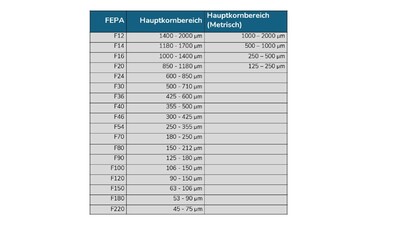
PARTICLE SIZE
White fused alumina is classified according to the European standard FEPA F for abrasive bodies, but is also available in metric sizes.
MANUFACTURE of high-purity corundum
Synthetic fused alumina is produced from calcined bauxite rock with a high alumina content in a three-step process. In the first step, ground bauxite is suspended in caustic soda. Under pressure and at high temperature, digestion takes place in a reaction vessel, during which the caustic soda extracts the aluminum compounds from the bauxite. After further chemical and physical process steps, aluminum hydroxide is obtained. At temperatures exceeding 1000°C, a subsequent calcination process takes place, during which the material is dehydrated and reduced to aluminum oxide.
Other bauxite byproducts, such as insoluble iron and heavy metal compounds, remain in the alkaline suspension and are deposited as red mud and disposed of as hazardous waste.
The alumina obtained in this way is modified into synthetic high-purity corundum (α-Al₂O₃) in an energy-intensive melting process at temperatures exceeding 2,100°C. Due to the manufacturing process, high-purity corundums therefore belong to the family of electro-corundums (ELK). The corundum melt is then cast into blocks so that it can cool and solidify over several days. The corundum blocks are crushed into granules in crushers and mills and undergo further purification steps. The high-purity corundum is then screened and classified by particle size.