
Aluminum Oxide vs. GRITTAL®: A Cost-Effective Alternative
Are you currently blasting with aluminum oxide?
See how GRITTAL® compares with aluminum oxide and when switching to reusable stainless steel blasting media can help reduce media consumption, dust, waste, and overall operating costs.
Is GRITTAL® an alternative to aluminum oxide?
Yes. GRITTAL® can replace aluminum oxide in many industrial blasting applications.
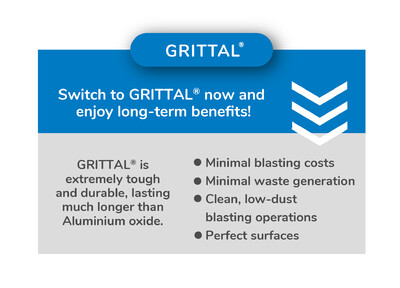
Aluminum oxide is extremely hard but brittle, while GRITTAL® is tough and dimensionally stable. Depending on the application, GRITTAL® can be reused for up to 600 blasting cycles.
Its lower breakdown rate can significantly reduce media consumption, dust generation, waste, and disposal requirements. At the same time, the operating mix remains stable for longer, supporting consistent and repeatable surface results.
GRITTAL® is particularly suitable for cleaning, surface roughening, and surface preparation of metal components.
Aluminum Oxide vs. GRITTAL® – What's the Difference?
Aluminum oxide, also known as corundum, is a very hard and highly abrasive mineral blasting media. However, its brittle structure causes the particles to progressively fracture during blasting. This creates fines and dust, while spent media must continually be replaced.
GRITTAL® is an angular stainless steel blasting media made from a corrosion-resistant chromium cast alloy. Its particles are significantly tougher and retain their shape longer, allowing the media to circulate through the blasting process many times.
The key difference:
Aluminum oxide provides high hardness and aggressive cutting action. GRITTAL® combines an angular particle shape with high toughness, lower particle breakdown, and significantly greater reusability.
Aluminum Oxide vs. GRITTAL®: When Does Switching Pay Off?
Compare aluminum oxide and GRITTAL® for media consumption, service life, dust, waste and operating costs – and find out when switching makes sense.
| Property | Aluminum Oxide | GRITTAL® |
|---|---|---|
| Material | Aluminum oxide / corundum | Corrosion-resistant chromium cast alloy |
| Particle shape | Angular | Angular |
| Particle behavior | Extremely hard and brittle | Tough, hard and dimensionally stable |
| Particle breakdown | Comparatively high | Significantly lower |
| Reusability | Limited | Up to 600 cycles* |
| Dust generation | High | Very low |
| Media consumption | Higher | Significantly lower |
| Waste volume | Comparatively high | Significantly lower |
| Operating mix | Changes more quickly | Remains stable longer |
| Equipment wear | High | Moderate |
| Blasting equipment | Primarily air blast systems | Air blast and wheel blast systems |
| | Cost efficiency | Lower media price, higher ongoing consumption | Longer service life, lower ongoing consumption |
| Recycling | Limited options** | Recyclable as metal** |
* Actual service life depends on the workpiece, blasting equipment, particle size, and process parameters.
** Recycling options depend on contamination, composition, and local recycling and disposal requirements.
Case Study: How Much Can You Save Compared With Aluminum Oxide?
The impact of media reusability on actual blasting costs can be seen in a real-world example involving the surface treatment of tank containers.
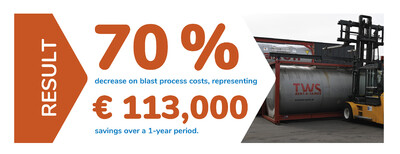
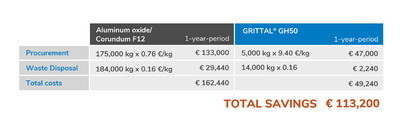
Tank container application – one-year cost comparison
A realistic comparison between aluminum oxide and GRITTAL® should not be based solely on the purchase price per pound.
The total cost of the blasting process should also include:
- media purchase and consumption
- ongoing media replenishment
- media service life
- waste volume
- disposal costs
Because GRITTAL® can be reused many times, ongoing media consumption can be significantly lower than with aluminum oxide.
The key factor is not simply how much one pound of blasting media costs, but the total cost required to achieve the specified blasting result.
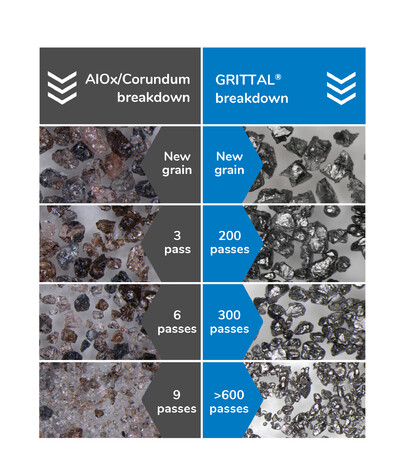
How Do Aluminum Oxide and GRITTAL® Compare in Particle Breakdown?
Aluminum oxide is extremely hard, but it is also brittle. When the particles impact the workpiece, they progressively fracture into smaller particles and fines.
GRITTAL® is significantly tougher. Its particles wear more slowly and retain their shape through many blasting cycles.
Depending on the application, GRITTAL® can achieve up to 600 blasting cycles.
Lower particle breakdown means fewer fines, less media replacement, and a more stable operating mix.
Key takeaway
The lower the particle breakdown, the longer the blasting media can remain in circulation. This directly affects media consumption, dust generation, waste volume, and ongoing process costs.
Why Can GRITTAL® Be More Cost-Effective Than Aluminum Oxide?
Lower Media Consumption
Because of its brittle structure, aluminum oxide progressively breaks down during blasting. Spent media and fines are removed from the process and must continually be replaced.
GRITTAL® wears more slowly and remains in circulation much longer. This can significantly reduce ongoing media replenishment.
Less Dust
As aluminum oxide breaks down, it generates fines and dust.
GRITTAL® has a much lower breakdown rate, resulting in fewer fine particles. This supports a cleaner, lower-dust blasting process and reduces the amount of media removed from the system.
Less Waste and Lower Disposal Costs
Lower media consumption also means less spent blasting media requiring disposal.
This can reduce both waste volume and media-related disposal costs.
Reduced Equipment Wear
Aluminum oxide and its sharp fractured particles can cause significant wear on blast nozzles, hoses, and other equipment components.
GRITTAL®'s lower breakdown rate can help reduce media-related wear on blasting equipment.
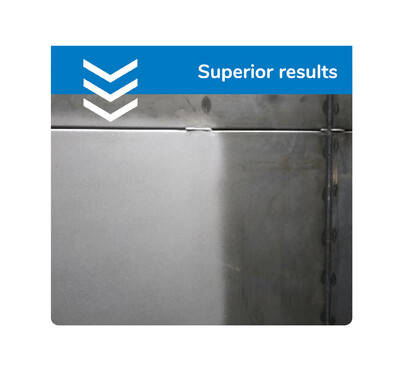
Consistent Surface Results
Because GRITTAL® retains its shape longer, the operating mix changes more slowly.
This helps maintain consistent surface roughness and repeatable blasting results over longer production runs.
When Does It Make Sense to Switch From Aluminum Oxide to GRITTAL®?
Switching from aluminum oxide to GRITTAL® can be particularly attractive when:
- large quantities of aluminum oxide are consumed,
- the blasting process generates high levels of dust,
- large volumes of spent media require disposal,
- disposal costs are a significant cost factor,
- blasting equipment experiences high wear,
- consistent surface roughness is required
- repeatable surface results are critical,
- wheel blast equipment is used, or
- the goal is to reduce the total cost of the blasting process.
Whether GRITTAL® is a technically and economically suitable alternative depends on the specific application and process parameters.
What Applications Can Replace Aluminum Oxide With GRITTAL®?
GRITTAL® can be an alternative to aluminum oxide in many industrial applications where an angular blasting media and a defined surface profile are required.
Typical applications include:
- cleaning metal surfaces
- removing scale and surface residues
- surface roughening before coating
- surface preparation for powder coating
- surface preparation for liquid coatings
- preparation for corrosion protection systems
- matting and texturing
- processing steel, stainless steel, and selected non-ferrous metals
Is GRITTAL® the Right Aluminum Oxide Alternative for Your Process?
Aluminum oxide is not necessarily the wrong blasting media. The technically and economically best solution depends on the material, workpiece, required surface roughness, blasting equipment, and desired surface result.
Whether GRITTAL® is a suitable alternative to aluminum oxide for your application can be evaluated under realistic process conditions.
At the VULKAN INOX Test Center, customer workpieces can be blasted with our stainless steel blasting media. Different process parameters and GRITTAL® particle sizes can be tested to determine the appropriate blasting result for the specific application.
Frequently Asked Questions: Aluminum Oxide vs. GRITTAL®
Is GRITTAL® an alternative to aluminum oxide?
Yes. GRITTAL® can replace aluminum oxide in many industrial blasting applications. Particularly in repetitive blasting processes, its high reusability and lower particle breakdown can provide significant economic advantages.
What is the difference between aluminum oxide and GRITTAL®?
Aluminum oxide is an extremely hard but brittle mineral abrasive. GRITTAL® is an angular metallic blasting media made from a corrosion-resistant chromium cast alloy. It is significantly tougher, breaks down more slowly, and can be reused many more times.
Which is more cost-effective – aluminum oxide or GRITTAL®?
It depends on the application. Aluminum oxide has a lower purchase price per pound. However, GRITTAL®'s longer service life and lower consumption can significantly reduce ongoing process costs. A meaningful comparison should therefore consider the total cost of the blasting process, not just the media purchase price.
How many times can GRITTAL® be reused compared with aluminum oxide?
Depending on the application and process conditions, GRITTAL® can achieve up to 600 blasting cycles. Aluminum oxide breaks down much faster because of its brittle structure. Actual service life depends on the equipment, workpiece, particle size, and process parameters.
Does GRITTAL® generate less dust than aluminum oxide?
Yes. GRITTAL®'s lower breakdown rate generates fewer fine particles, which can significantly reduce dust and the amount of media removed from the blasting system.
Can GRITTAL® achieve the same surface roughness as aluminum oxide?
GRITTAL® is also angular and can create a defined surface profile. The achievable roughness depends on particle size, blasting pressure, equipment, workpiece, and other process parameters. A blasting trial can help determine the appropriate GRITTAL® grade and process settings.
Can GRITTAL® be used in wheel blast equipment?
Yes. GRITTAL® can be used in both air blast and wheel blast equipment. Aluminum oxide is not recommended for wheel blast systems because of its high wear potential.
When should I consider switching from aluminum oxide to GRITTAL®?
A switch can be particularly attractive when aluminum oxide consumption is high, large amounts of dust and waste are generated, disposal costs are significant, equipment wear is high, or consistent and repeatable surface results are required.
Related Information
Aluminum Oxide as Blasting Media
GRITTAL® Stainless Steel Blasting Media
Learn how free iron contamination can occur on stainless steel surfaces and how it can be prevented during surface treatment. Iron Contamination on Stainless Steel